
Welcome Visitor. First time here? Like what you see? Bookmark us for when you are bored, and check out 'top shots' and 'fantastic (editors choice)' in the menu above, you won't be dissapointed. Join our community!
click here to sign up for an account today. Sick of this message? Get rid of it by
logging-in here.
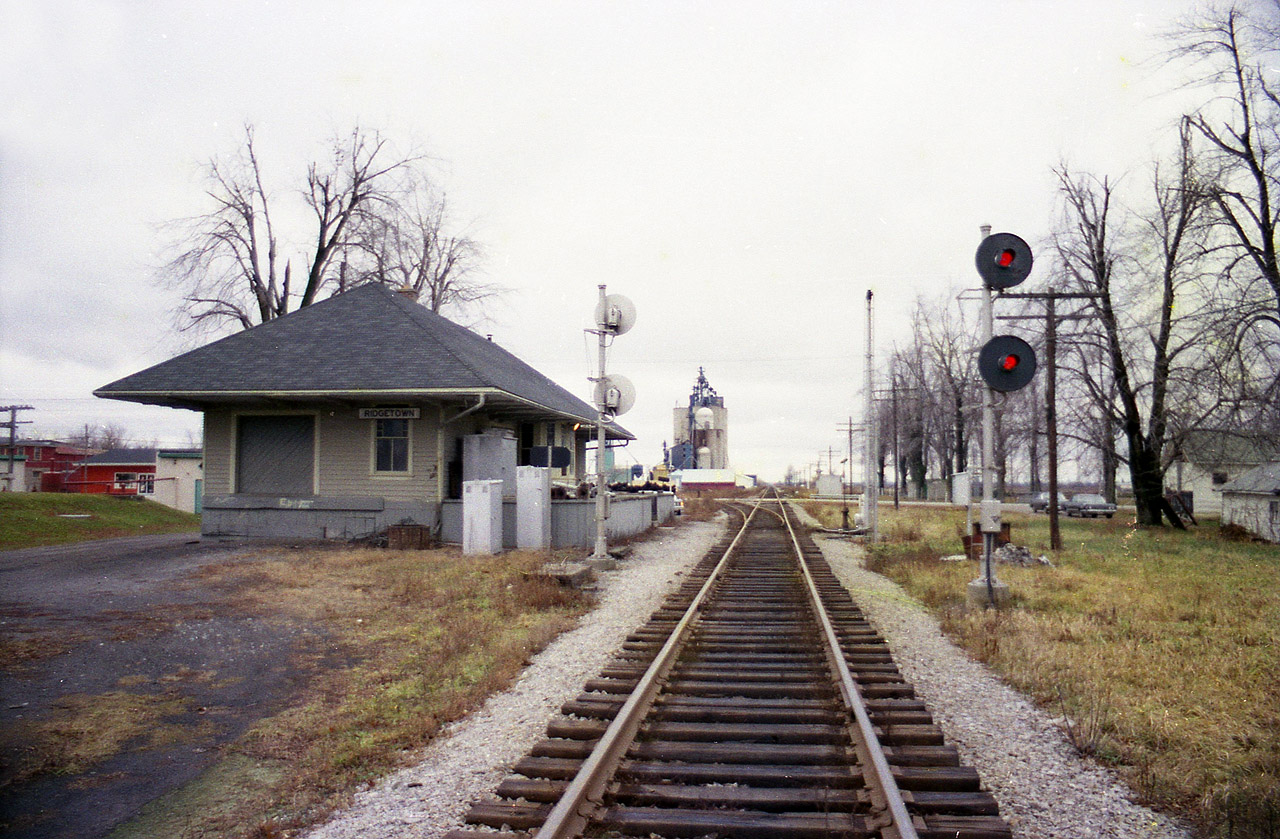


Hmm I don’t remember a C&O Keep Out sign.. visited this station in 2014…
Still used by the Signals Dept.
Nice capture. Lots of signal stuff to see.
Amazing photo. The station was torn down on june 1st, 2026
Another bit of history gone, but recorded at least by many including you Arnold.
I would be interested in knowing why there are two opposite facing double aspect “home” signals so close together with no apparent need such as a power switch, diamond, or interlocked bridge?
CTC extended from Pelton (C&O-NYC diamond near Windsor) to this exact spot. From here to St. Thomas was dark territory.
So the Absolute signal facing away from Arn is the governing signal for all eastbounds. Just to the left and below it, also facing away from the camera, is the metal sign that read ” End CTC”.
Likely in much olden times Ridgetown was the location where all eastbounds got their train order running orders. But as the personnel were reduced, that task was later performed at Blenheim, a true 24-hour station through the 60s and 70s.
So the signal facing the camera if you notice has no number plate. It’s a true Stop and Stay.
The passing siding is beyond the road, to the right of the mainline. It’s a hand throw switch for entering. At the west end, there was an Absolute for the main track and a dwarf signal for the siding, to proceed further west. However the west end was a spring switch.
I could be wrong but a westbound coming out of dark territory and having to take this siding, may have received a Restricting signal in order to at least crawl to the tall switch. I never personally had that type of situation crop up, so I’m merely speculating.
Curving around to the left, off the first hand throw switch, is the lead to the elevator track (to the left of the mainline) and the beginning of the Town Spur. That went across Main Street and continued a quarter of a mile to a company called Tube Turns. They brought in steel coils in the traditional covered coil cars and made automotive and other types of steel tubing. Outbound shipments usually went in box cars ( just an extra note for the modellers…).
I should add, that in a pinch, if it were void of cars, the elevator track would be used to have two larger trains consummate a meet here.
I heard of it happening, perhaps once or twice, but again was never involved in such a situation.
And yes, for a westbound to enter the passing siding (beyond the road crossing) required the use of a hand throw switch, connected to a derail, and an electric lock.
Thanks for the detailed reply Bruce. On CP, we had a similar setup at Zorra decades ago, at least in terms of the signal we’re facing in this photo. The difference on ours was staggered aspects instead of absolute signals, because we were in ABS territory. The staggered aspect signals conveyed “stop & proceed at restricted speed . At Zorra, that allowed trains operating in either direction to go to the switch or beyond, depending on who was taking the siding. That was dictated by train orders or later, an OCS clearance. We had a setup at Dixie on the Galt Sub before CTC was installed in 1980-81, that was similar to that for trains in Arnold’s photo, proceeding from CTC to dark territory. When westward trains went from CTC at Dixie to the westward signalled double track (ABS with the current of traffic), we received a signal appropriate to the condition in the first couple of blocks. For example. stop if a trains was ahead of us, “approach” (later clear to Stop) if a trains ahead was in the next block etc.
On the other hand, if we were routed against the “current of traffic” on the eastward track, we were in defacto “dark” territory. I can’t recall the last CTC signal we got in that situation, as it was quite rare. I would guess that it would have been either restricting, or more likely clear, which only gave authority to the end CTC sign. The signal leading to ‘dark” territory in this photo must have only offered authority to the “end CTC sign, as the signals could not detect anything in the dark territory. We also had an electrically locked hand throw switch at the east end of Walkerville Siding on the Windsor Sub. If a westbound was was required to take the siding, the “stop & stay signal” actually had a take siding display red over flashing red. On the basis of my recollections, perhaps the C&O’s setup in the picture isn’t as odd as I first thought.