
Welcome Visitor. First time here? Like what you see? Bookmark us for when you are bored, and check out 'top shots' and 'fantastic (editors choice)' in the menu above, you won't be dissapointed. Join our community!
click here to sign up for an account today. Sick of this message? Get rid of it by
logging-in here.
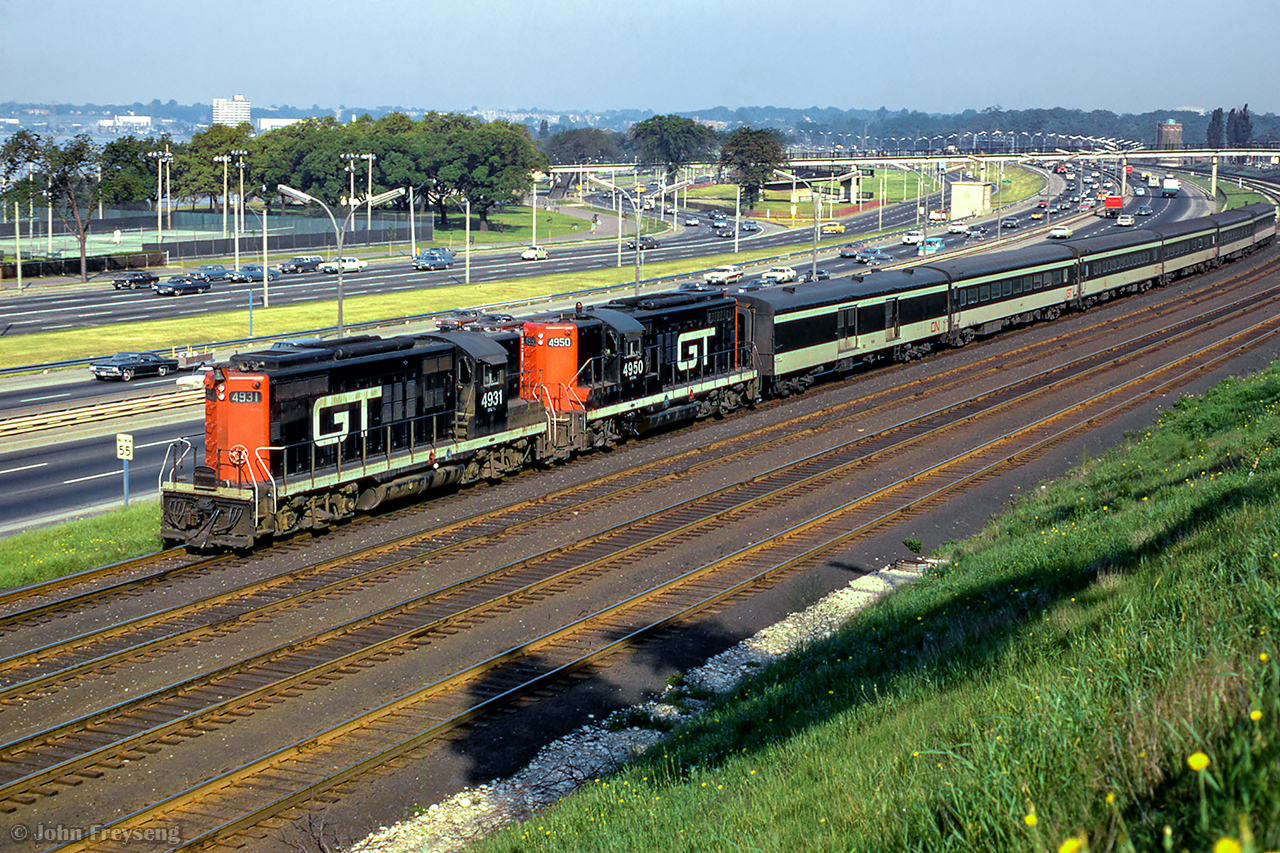

Note the two Grand Trunk Western coaches up front. Great shot, John!
Beautiful shot John!
Thanks Ian and John. Got up early that morning and took a little detour on my way to work at 365 Bay St in downtown Toronto, and now glad I did that, John
So this brings up a question I’ve had for some time now – these GT Geeps were quite common especially on trains that ran through Sarnia to Toronto just after steam ended and well into the 70′s. at some point, they started roaming all over the CN system in particular use in Ontario on various trains including locals.
https://www.railpictures.ca/?attachment_id=58884
The paul chapman photo linked above is a great example posted a few days after this shot.
I’ve seen photos of these GT geeps used on locals – at a UCRS meeting a couple months ago someone had one shot in a slideshow, just 2 cars and a caboose at Bayview, also early to mid 70′s.
Then at some point, all of these GT locomotives went back to the USA and basically stayed there except run through trains (such as the Laser, etc)
Only in recent years did GT geeps start appearing in Canada again – and of course in blue, not black.
The question is – what happened and why did they pretty much end up retreating back to the USA?
In this period in Johns photo – the early to mid 70′s they still seem fairly common
I just don’t have the history behind it and hoping to help piece it together by those who were in the know at the time.
thanks all!
The final run of trains 156/155 with shared power, CN and GTW, was June 6-70 eastbound and then out again that evening. I’m guessing John was here this morning to document one of those final moves.
After that, there was power sharing on a pair of trains, 158/159, via Stratford, with GT power until sometime in 1971. But it wasn’t the remnant of the INTERNATIONAL, which 155/156 were downgrades from.
After that, any GT power that came here was a “” lease “” for the mothership, or a transfer to New England subsidiaries CV and GT.
Lots of GP9/18 leases to CN in 1971 and then 1973/74 which explains that 4922 on the Welland bridge etc.
Thank you Bruce for that great explanation. This leads me to the next question – since at that time GT/CN/CV were all operated as separate entities, at some point the motive power was released from the shackles of those entities.
I can only point to modern examples: CN Canadian GP9′s rarely work in the USA. There are examples of this in Detroit area though (videos on youtube in the 90′s) – perhaps those GP9′s were leased from the Canadian entity/mothership? PTC is a reason why Canadian units don’t generally cross the border today – there are zero Canadian GP9′s assigned in the USA and any that do cross are going for mechanical work (East St Louis, etc).
In modern times, Grand Trunk four axle units have been roaming assigned to “Great Lakes/Greater Toronto” for some time now – about 10-15 years. Only about 3-4 units but still, here they are.
There are now Divisions (Great Lakes, Gulf, Midwest, etc) and zones (Greater Toronto, Montreal, etc) and I assume whenever the current structure came into place (Probably at the time of the CN/IC merger) I assume the old structure was dissolved, and now power is assigned to the division/zone.
A number of SD40-2′s were re-assigned from the DMIR to Toronto fairly recently and now work the hump for example.
Thank you all for your insight.
Perhaps there are other people who can summarize it best. But if you keep in mind that CN owned GTW, CV, DW&P and GT of New England like since 1928, it makes it simpler.
Sure, there have been corporate changes, as in GT Corporation in the 1980′s, who then purchased DT&I and DTSL. And overview of the New England properties always fell to GTW’s care.
Operationally, like trains 155/156 and in the 1950s/60s freights 490 and 491, there were motive power sharing arrangements. I can’t speak to the actual rotation times ( ie, every 60 days or 90 days etc) but along the Kingston Sub. you would see CV/GT power on those hot freights. And west of Toronto you would see the 4900 geeps taking the Chicago trains. All through this timeframe, the mixture of CN power on those trains was fairly consistent ( ie, 155/156 were pretty much all GMD 65/6600′s).
Into the 70s any power being used on the other guy’s plant was considered a lease.
For a time several CN rebuilt GP9′s were assigned to the IC because they were ‘owned’ ( examples are 4000,4006, 4009, 4010, 4015, 4016, 4024, 4027, 4028, 4030, 4031 and 4034).
When retired and purged all of those were sold within the USA.
I don’t follow your statement regarding PTC.
Battle Creek undertook the same program as Pte. St. Charles, rebuilding older geeps into the 9RM configurations.
DW&P engines were reassigned to the CV. Then GTW engines were reassigned to DW&P. And on and on….
To add to Bruce’s excellent explanation, I would add that Central Vermont/Grand Trunk (New England)/Duluth Winnipeg & Pacific units assigned to St. Albans ran into Taschereau Yard in Montreal until at least summer 1978; after that CN units took the trains south to St. Albans and CV power normally took the train south to Palmer, MA until run-throughs started in the early 1990s prior to the sale of the CV. (CN units were used on the GT (NE) freights to and from Portland from the 1960s, from what I know.)
When the “Laser” trains to and from Chicago started in the mid-1980s, they initially ran with a set of CN power and a set of GTW power and later with a mixture of CN and GTW units. GTW repaid horsepower hours with several GP40-2s that ran around southern Ontario in the late 1980s. When CN started to integrate Grand Trunk Corporation (GTW, DWP, and CV) in 1993 and opened the “new” Sarnia tunnel in 1995, run-through trains became more common and GTW units (GP38-2s, GP40-2s, SD40s, SD40-2s) started appearing on trains between GTW terminals and MacMillan Yard/Taschereau Yard. This lasted until the late 1990s when the SD75s and C44-9s started to hold down through trains replacing the smaller GTW units. After the Illinois Central purchase in 1999, many GTW units moved to former IC lines and older IC GP8s and GP10s were retired. GTW units have started to re-appear as older CN yard and roadswitcher units are retired.