|
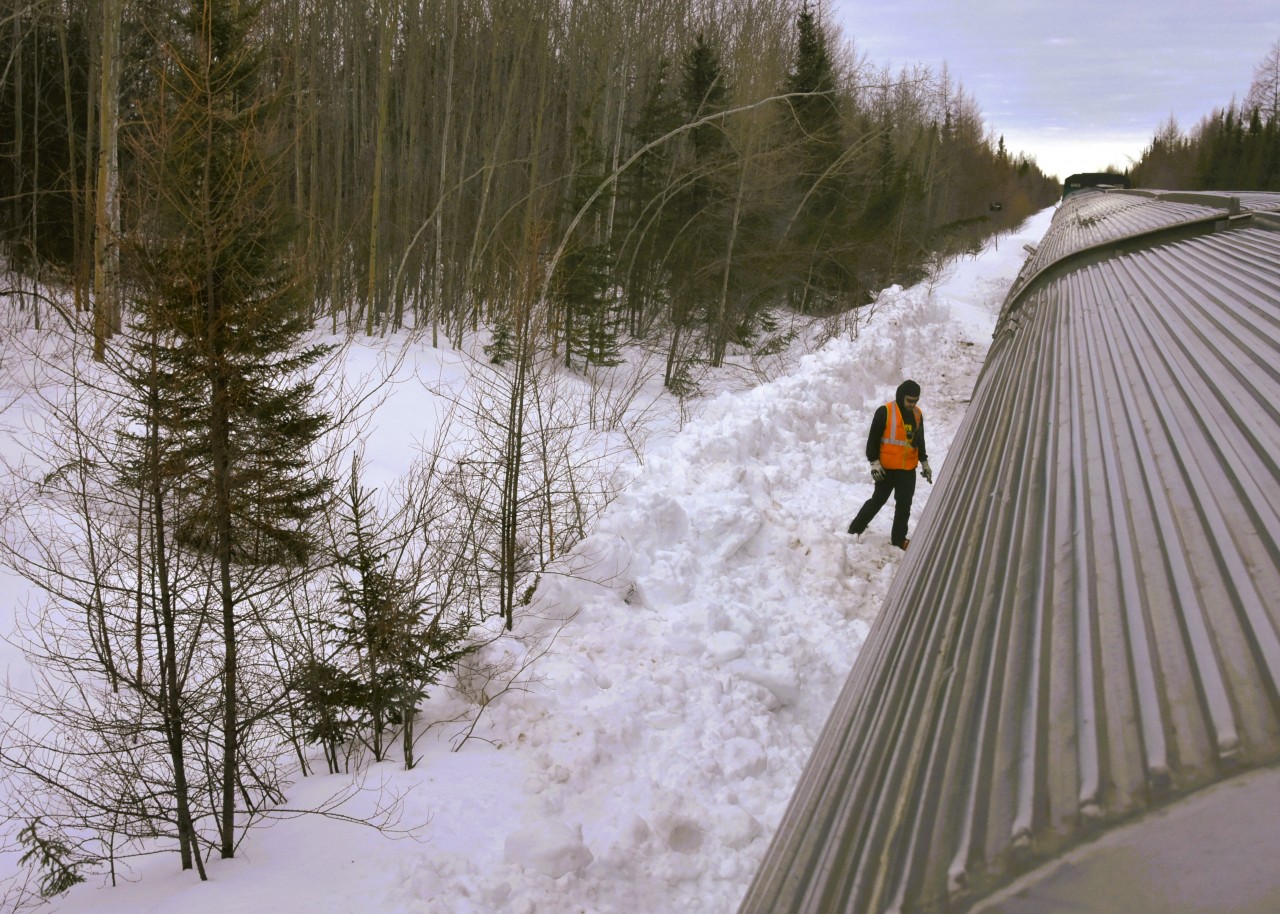
Caption: No HBD, no problem!
There are a few new electronic Hot Box Detectors on the HBR's subdivisions between The Pas and Churchill, but where they have yet to be installed, the hand-held laser gun method is deployed every 40 or so miles along the remote route.
Seen here is VIA 692's second engineer, who has climbed down from the left side of the locomotive cab at Munk, MB Mile 269.0 on HBR's Thicket Sub. to use a laser temperature sensing device to check the axle bearings on each car in the trains consist.
A slow roll-by of the entire length of the train from locomotive to the tail end sleeper, a stop, a crossover to the other side, then a slow reverse movement to check bearings on the opposite side is undertaken before reboarding the locomotive and continuing the journey.
This procedure is done at predetermined, safe, and snow cleared locations along the way.
It sure beats the old Tempilstik method! :-)
|


How times have changed!!!!!
Nice!
As long as those laser gun batteries maintain their charge – in the cold!
Oh, and memories travelling The Canadian, on the CPR – the sixties ‘high tech’ way: at every crew change a foreman / trainman / switching crew (at Sudbury) would walk the train placing a hand on every journal bearing…
sdfourty
I find this crazy this is how they have to operate – but then again, there isn’t much hydro/electricity power in these remote areas. But should be enough to cover most of it if you install near the towns that actually have electricity.
But most railways would use the pole line for this in remote areas no? So what happened to the pole line on the HBRY…?
Also I didn’t realize the VIA train has to take the branch to go to Thompson then back out on the way. There’s so many branchlines on the route to Churchill still in place going almost nowhere, such as the Kelsey branch which runs to a generating station with no roads. Not a customer in sight but the line is all still intact.
There were two new HBD’s north of Thompson Jct. that I noticed on this most recent trip. HBR continues to improve the infrastructure at a steady rate that has been quite noticeable since my first trip to Churchill in 2022.
I would expect there will be more electronic scanning equipment added every work season going forward.
The tripod pole line along the HBR right-of-way has been decommissioned for decades. There is electric power at most communities and other select locations along the Churchill mainline but many areas remain without for now. With all the new hydro towers along the route I don’t think it will be difficult, or too long before the railway has power along its entire length.
The wye at Thompson Jct. Mile 199.8 on the HBR’s Thicket Sub. is where both HBRY freight and VIA passenger trains access the Thompson Sub. for the 30.5-mile slow roll to the town of Thompson, MB. Just outside Thompson Yard at HBR Wingate Mile 28.9 Thompson Sub. VIA 693/693 use the wye and back through the yard to the station track.
All trains leave Thompson Yard in the forward direction towards Thompson Jct. and the HBR Thicket Sub.
I’ll be taking the trip again in the third week of October and will be watching for more infrastructure upgrades.
Oops! Train numbers in the second to last paragraph of my comment should read VIA 693/692 .
Steve, here are a couple of pics of the decommissioned pole line on the HBR between The Pas and Churchill. Not much juice flowing through those wires.
https://www.flickr.com/photos/197431498@N07/55285712041/in/photolist-2sepJ4K-2seqs6C
https://www.flickr.com/photos/197431498@N07/55285853438/in/photolist-2sepJ4K-2seqs6C
And to think we used to run from Capreol to Hornepayne (296.2 miles) and never give the train a second look.
From my notes, photos, and information provided by my brother, here are the current locations of wayside electronic detection devices on the HBRY
HBR Wekusko Sub. Mile 40.9 Cormorant, MB
HBR Wekusko Sub. Mile 81.2 Wekusko, MB
HBR Wekusko Sub. Mile 126.2 Pipun, MB
HBR Thicket Sub. Mile 183.8 Thicket Portage, MB
HBR Thicket Sub. Mile 285.5 Ilford, MB