|
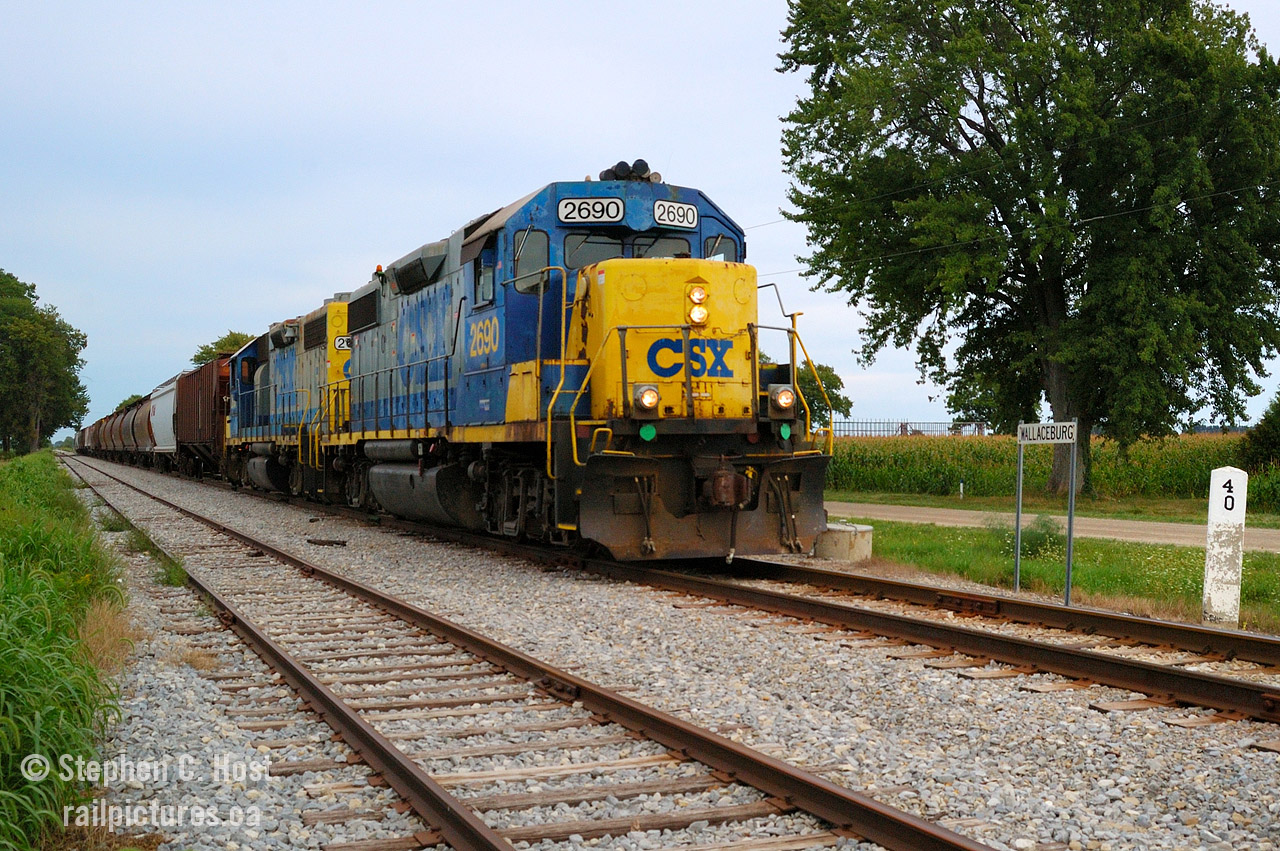
Caption: Concrete mileposts that date back to the Erie & Huron Railway, a "new" station name sign as this was the Wallaceburg siding (Bruce - was this a re-located name sign when the station ceased to exist?) and D724 passing it all - in reality, this was the only siding that was actually used to meet trains from time to time and as you can see it was still in use. Most often it was used to run-around, and I did see parked cars in the siding after the big freights stopped operating in '06, but in this era it seems to have been kept clear for operational flexibility. The "new" wallaceburg siding was about 6000 feet in length. Here's an audio recording with a clearance to Wallaceburg taking the siding at Wallaceburg.
Here's something neat: I didn't realize the names "Subdivision No 1" and "Subdivision no 2" went as far back as the Pere Marquette. Check this out! Get a copy before this link is no longer valid folks.
https://wx4.org/to/foam/maps/2-Zukas/30/O/1939-04-09PM_Canadian16-Zukas.pdf
|


Here’s info on the last train from Wallaceburg all the way to Chatham on CSX:
https://www.trainorders.com/discussion/read.php?2,1090728
Nicely captured.
The round concrete “battery well” to the right of the locomotive pilot housed a “primary battery” most likely for a track circuit (Crossing or Bridge Interlocking). The typical primary battery used by railroads was caustic soda, later carbon-zinc. A primary battery was used when hydro power was unavailable. The primary battery required replenishing or replacement at regular intervals, typically 6 to 12 months depending on the application.
Photo co-ordinates – 42°35’32.7″N 82°21’50.5″W
I was wondering what that was and why it looked like a well. There is a signal just to the north (behind me, timetable north) which was the approach signal for the drawbridge which had a home signal naturally at the drawbridge. There was also a crossing behind the home signal by about 100 feet. Most of this is all still in place today just abandoned in place, owned by a company out of Mississauga.
Oh sure, now you’re asking me to remember the CROR and how it was minimally applied by CSX after I left in 1996. LOL
I could guess that the sign was moved from the bridge to here. I say that because before the CROR everyone operated under the old book, UCOR. Which didn’t necessarily have these ‘spotty’ station name signs (SNS) in places where you wouldn’t expect them. I’m pretty sure this sign was at the bridge for a time. It was put there long after the (real) station had closed.
The bridge is/was considered an Interlocking and I would imagine “”someone”" made a decision that it should have a designated name.
And yes, Subdivision 1 and 2 were used for their description for many decades. That style is US-originated, that plus things like 3rd Sub 10th District and etc.
Your photo is taken immediately south of the southern edge of the town. If we could see that far, off in the distance is the tiny hamlet of Tupperville ( too many trees ). This was the passing track and it was never 6,000 feet. It was around 60 cars, maybe 65 if you didn’t make a cut at the little cematary road just beyond the rear hopper. Also, at such point, there was a short crossover, which although can be seen in this photo, are not likely in service.
Not being an S&C guy, but having traversed these rails a thousand times, that concrete caisson was two-purpose – it held the connecting wiring and batteries for both the approaching crossing lights AND the Approach signal for the drawbridge. That signal was always displaying yellow until you entered that ‘block’ in which case if things were normal, it would go green within 10 seconds. If it stayed yellow, then you could expect to find the home signal (Absolute) just before the bridge at Stop.
Many of those concrete caissons were raised like this one but others were lower into the ground. They were a common feature for all crossings equipped with flashers. And of course they were situated at all the other interlockings on the Division.
FACTOID – there were no more than 5 crossings on the entire Division equipped with gates.
Thanks Bruce. The trainorders post indicates the division had fireman still on the board. When were firemen positions eliminated if you know?
I can only comment as of mid1996, I don’t know how much longer they were existing after that. But simply put, every job ( thru-freight, roadswitcher, yard assignment) had a fireman’s position. But for the most part, they were unfilled. It’s a complicated labor agreement that was intertwined with the creation of Guaranteed Spare Boards and Reserve Boards in the very late 1980s.
A Guaranteed board was a steady wage for being on call as needed 24/7/365. A Reserve board was a lesser wage but you weren’t subject to duty, except in unusual circumstances. And when you were called for duty, you had something like 14 days to respond and be put on the Guaranteed board. Reserve boards of which there were 1 at St. Thomas, would be a personal choice, because the wages were a little lower than a basic paid yard rate, just to sit at home but maintain your status and seniority.
Prior to these 2 provisions being created, the firemen who held a position at whatever terminal, were the men called for short term or sudden vacancies. As I say, they were largely unfilled positions because there was enough work for everyone, between regular assignments and the Guaranteed board.
Thank you that’s a great explanation. I find every Union contract had quite the layers of nuances and details that is difficult to understand. The Pere Marquette contract folks no different. I have a photo of the 2000′s issued Union contract booklet, and it even has a PM logo on the front, surprisingly.
I forgot to mention in my photo, which isn’t immediately obvious to everyone the train pictured is D724 returning from Blenheim, a typical tuesday/thursday run from Chatham to Blenheim and return to Sarnia.
The PM was entirely merged into C&O by July 1947 after a number of years of being partially owned. The labor agreements always referenced PM district for all the trackage in Michigan and Ontario that was the PM. Existing provisions, in 1947, were honored by C&O until (a) things needed to be changed; or (b) the employees covered by such provisions were retired.