Welcome Visitor. First time here? Like what you see? Bookmark us for when you are bored, and check out 'top shots' and 'fantastic (editors choice)' in the menu above, you won't be dissapointed. Join our community! click here to sign up for an account today. Sick of this message? Get rid of it by logging-in here.


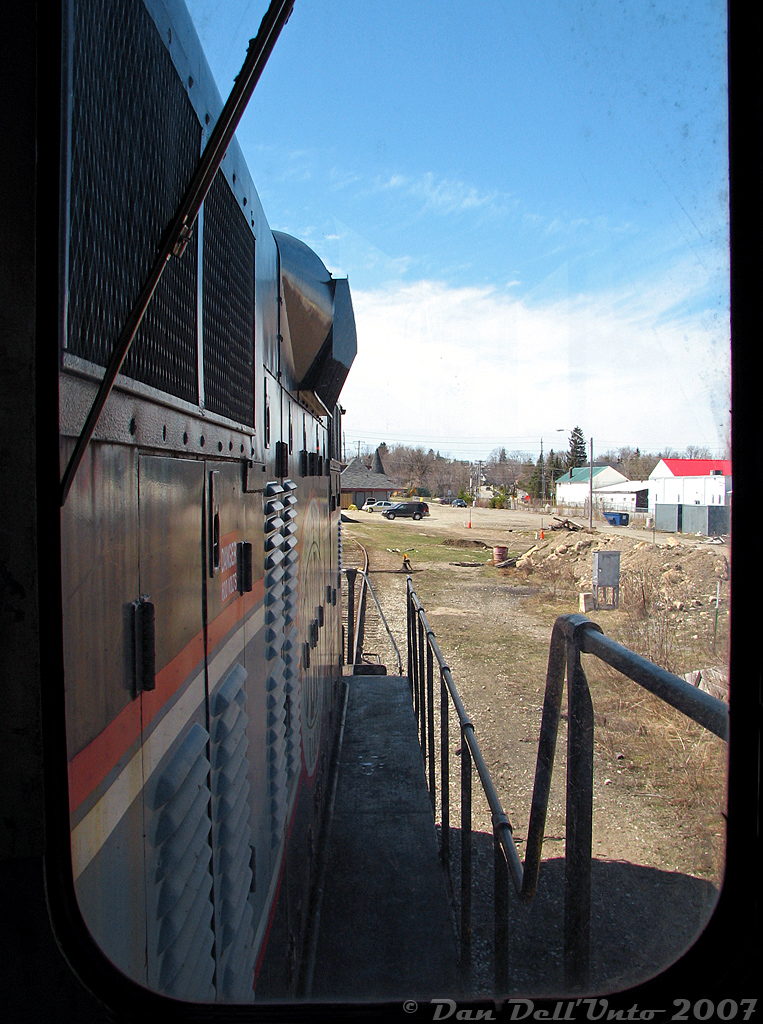
Here's the long-hood forward view while riding aboard Orangeville-Brampton Railway's CCGX 1000, a 1957 GMD-built GP9, as it runs around Orangeville Yard after completing its twice-weekly run to Streetsville and back. After dropping its lone car off in the yard, it was then filled up by local fuel dealer Bryan's Fuel and received some some light servicing from the engineer and conductor. Then the unit was moved around the yard and onto the station track to tie down on the Credit Valley Explorer's passenger equipment, effectively being put away for the day. In the distance is the OBRY's new Orangeville Station, and on the right is the site of the former CPR bunkhouse that burned down a few years prior. Another big thanks to Conductor Steve and Engineer Wayne for the short cab ride.

The GP9 was designed to be a bidirectional roadswitcher locomotive, but still had controls installed oriented for one end to lead or be designated the "front" of the unit. Dating from steam era practices, many railroads in the 1940's and 50's ordered their new diesel locomotives oriented for long-hood forward operation, putting the diesel engine and main generator in front of the crew and cab. One reason was for better accident protection in the event of a level crossing or head-on collision, another was crew familiarity after operating steam engines like this for so long. This practice gradually switched during the 50's and 60's as locomotives with low short hoods and better visibility became more popular. Quebec, North Shore and Labrador, Ontario Northland, and Canadian Pacific all ordered their Canadian-built GP7/GP9 units oriented for short hood forward operation, but Canadian National purchased their entire fleet as long-hood forward units. This would have been the view for a CN engineer for many decades operating a GP7/GP9, RS3/10/18 and other first generation diesels on mainline freights (even today, the 7000's and 7200's still have the controls oriented for long-hood forward operation).
Copyright Notice: This image ©Dan Dell'Unto all rights reserved.


Caption: Here's the long-hood forward view while riding aboard Orangeville-Brampton Railway's CCGX 1000, a 1957 GMD-built GP9, as it runs around Orangeville Yard after completing its twice-weekly run to Streetsville and back. After dropping its lone car off in the yard, it was then filled up by local fuel dealer Bryan's Fuel and received some some light servicing from the engineer and conductor. Then the unit was moved around the yard and onto the station track to tie down on the Credit Valley Explorer's passenger equipment, effectively being put away for the day. In the distance is the OBRY's new Orangeville Station, and on the right is the site of the former CPR bunkhouse that burned down a few years prior. Another big thanks to Conductor Steve and Engineer Wayne for the short cab ride.

The GP9 was designed to be a bidirectional roadswitcher locomotive, but still had controls installed oriented for one end to lead or be designated the "front" of the unit. Dating from steam era practices, many railroads in the 1940's and 50's ordered their new diesel locomotives oriented for long-hood forward operation, putting the diesel engine and main generator in front of the crew and cab. One reason was for better accident protection in the event of a level crossing or head-on collision, another was crew familiarity after operating steam engines like this for so long. This practice gradually switched during the 50's and 60's as locomotives with low short hoods and better visibility became more popular.

Quebec, North Shore and Labrador, Ontario Northland, and Canadian Pacific all ordered their Canadian-built GP7/GP9 units oriented for short hood forward operation, but Canadian National purchased their entire fleet as long-hood forward units. While on 1000 this is the conductor's view looking out the back, on a CN unit this would have been the engineer's view looking forward for many decades operating a GP7/GP9, RS3/10/18 and other first generation diesels on mainline freights (even today, the 7000's and 7200's still have the controls oriented for long-hood forward operation).

Photographer:
Dan Dell'Unto [1282] (more) (contact)
Date: 04/20/2007 (search)
Railway: Orangeville-Brampton Railway (search)
Reporting Marks: CCGX 1000 (search)
Train Symbol: Not Provided
Subdivision/SNS: Orangeville Yard - OBRY Owen Sound Spur (search)
City/Town: Orangeville (search)
Province: Ontario (search)
Share Link: http://www.railpictures.ca/?attachment_id=59928
Click here to Log-in or Register and add your vote.

5 Favourites
Photographers like Gold.Log-in or Register to show appreciation
View count: 64 Views

Share this image on Facebook, Twitter or email using the icons below
Photo ID: 58592

Map courtesy of Open Street Map

Full size | Suncalc


All comments must be positive in nature and abide by site rules. Anything else may be removed without warning.
No comments yet, be the first by adding yours below

Railpictures.ca © 2006-2026 all rights reserved. Photographs are copyright of the photographer and used with permission
Terms and conditions | About us