Welcome Visitor. First time here? Like what you see? Bookmark us for when you are bored, and check out 'top shots' and 'fantastic (editors choice)' in the menu above, you won't be dissapointed. Join our community! click here to sign up for an account today. Sick of this message? Get rid of it by logging-in here.


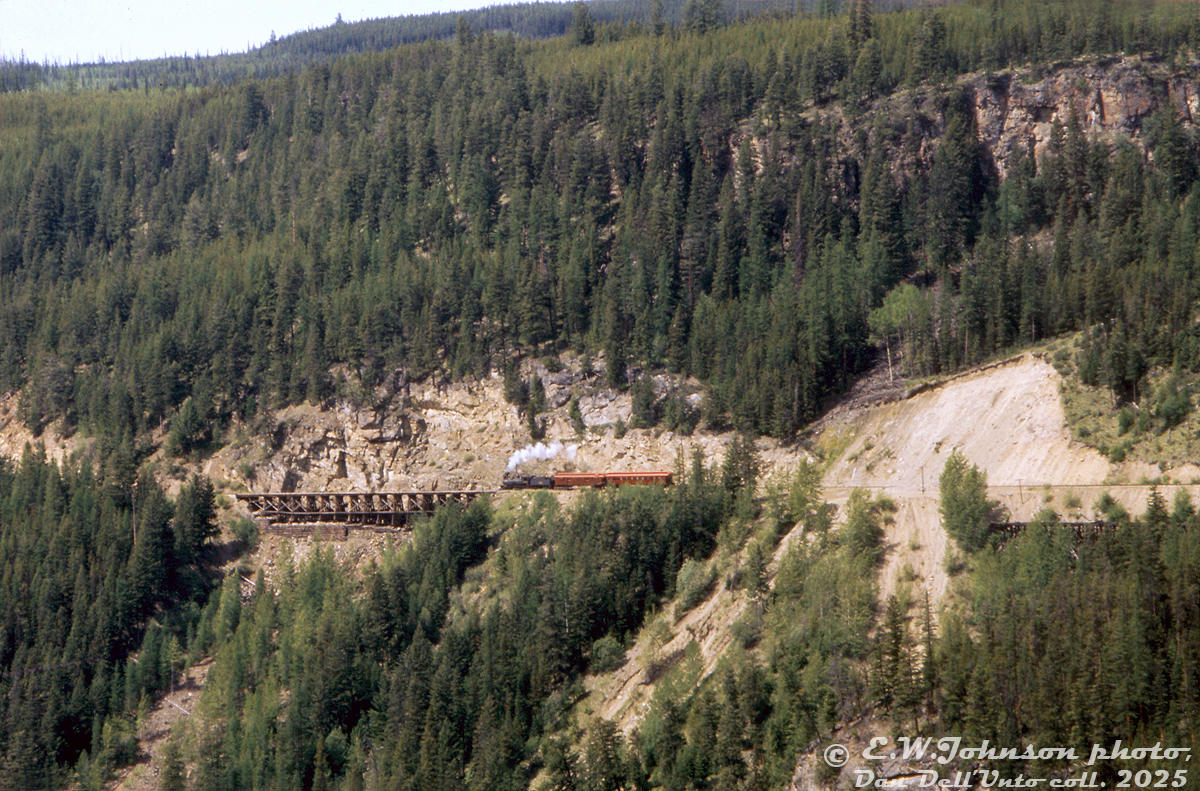
An early Canadian Pacific Railway 4-4-0 steams through the rough Rocky Mountain landscape out west, hauling two wooden passenger cars through mountainside wilderness cut through by steel rails laid over wooden trestles and through rock cuts, along the new transcontinental railway line spanning Canada from coast to coast.

That was the intent the CBC's film directors wanted to portray - a rocky, rough, sometimes treacherous, and vastly untamed mountain wilderness that the transcontinental railway line had to be built through in western Canada. And for that film crews (guided by technical consultants like Omer Lavallee) turned to the Carmi Sub in Myra Canyon (east of Penticton BC) for shooting various scenes for their 1974 film adaptation of Pierre Berton's "The National Dream" book on building the Canadian Pacific Railway. 

CPR 4-4-0 136 (double-billed as both 136 and 148 for different scenes) was borrowed from the Ontario Rail Association and backdated to a late 1800's appearance, and some vintage passenger and freight equipment was rounded up by CP from their work car fleet across the system and turned into close-to-period-correct cars for use during the different filming scenes.

Operations on this section of the Carmi Sub (Beverdell to Pentiction) had recently been discontinued by CP, but the line was reopened one last time for filming all the mountain scenes. Upon completion of filming, a diesel locomotive and caboose were dispatched for one final movement in order to retrieve the film's railway equipment and forward it to other parts of the system. A small section of the line to the east saw service for a short period longer, but The National Dream filming were the last train movements on the western part of the Carmi Sub. The line has since been converted into a popular walking/cycling trail.

Eric W. Johnson photo, Dan Dell'Unto collection slide.

More from The National Dream:
Tracklaying: http://www.railpictures.ca/?attachment_id=55064
Filming: http://www.railpictures.ca/?attachment_id=55074
Prairie consist: http://www.railpictures.ca/?attachment_id=56449
Copyright Notice: This image ©E.W. Johnson photo, Dan Dell'Unto coll. all rights reserved.


Caption: An early Canadian Pacific Railway 4-4-0 steams through the rough Rocky Mountain landscape out west, hauling two wooden passenger cars through mountainside wilderness cut through by steel rails laid over wooden trestles and through rock cuts, along the new transcontinental railway line spanning Canada from coast to coast.

That was the intent the CBC's film directors wanted to portray - a rocky, rough, sometimes treacherous, and vastly untamed mountain wilderness that the transcontinental railway line had to be built through in western Canada. And for that film crews (guided by technical consultants like Omer Lavallee) turned to the Carmi Sub in Myra Canyon (east of Penticton BC) for shooting various scenes for their 1974 film adaptation of Pierre Berton's "The National Dream" book on building the Canadian Pacific Railway.

For the live steam scenes, CPR 4-4-0 136 (double-billed as both 136 and 148 for different scenes) was borrowed from the Ontario Rail Association and backdated to a late 1800's appearance, and some vintage passenger and freight equipment was rounded up by CP from their work car fleet across the system and turned into close-to-period-correct freight and passenger cars for use during the different filming scenes, including the track laying and general scenic scenes such as this.

Operations on this section of the Carmi Sub (Beverdell to Pentiction) had recently been discontinued by CP, but the line was reopened one last time for filming all the mountain scenes. Upon completion of filming, a diesel locomotive and caboose were dispatched for one final movement in order to retrieve the film's railway equipment and forward it to other parts of the system. A small section of the line to the east saw service for a short period longer, but The National Dream filming were the last train movements on the western part of the Carmi Sub. The line has since been converted into a popular walking/cycling trail.

Eric W. Johnson photo, Dan Dell'Unto collection slide.

More from The National Dream:
Tracklaying: http://www.railpictures.ca/?attachment_id=55064
Filming: http://www.railpictures.ca/?attachment_id=55074
Prairie consist: http://www.railpictures.ca/?attachment_id=56449

Photographer:
E.W. Johnson photo, Dan Dell'Unto coll. [1113] (more) (contact)
Date: 06/20/1973 (search)
Railway: Canadian Pacific (search)
Reporting Marks: CPR 148 (136) (search)
Train Symbol: Special (search)
Subdivision/SNS: Myra Canyon - CP Carmi Sub (search)
City/Town: Myra (search)
Province: British Columbia (search)
Share Link: http://www.railpictures.ca/?attachment_id=58017
Click here to Log-in or Register and add your vote.

16 Favourites
Photographers like Gold.Log-in or Register to show appreciation
View count: 498 Views

Share this image on Facebook, Twitter or email using the icons below
Photo ID: 56687

Map courtesy of Open Street Map

Full size | Suncalc


All comments must be positive in nature and abide by site rules. Anything else may be removed without warning.

4 Comments
  1. IMHO, the greatest production to ever come out of the CBC. Also a must for anyone who wants to understand Canadian history.

  2. Incredible.

  3. This looks like the spot

    https://youtu.be/5maSp7OpE5c?si=NOXB3fZQVAMmii21&t=1553

  4. Steve, looks to be around the same area, although not the exact same spot shown.

    One thing I noticed is the series often featured a who’s who of 70′s Canadian film and TV, including John Colicos, Ken Pogue, Robin Gammill, Chris Wiggins and John Horton.

Railpictures.ca © 2006-2026 all rights reserved. Photographs are copyright of the photographer and used with permission
Terms and conditions | About us