Welcome Visitor. First time here? Like what you see? Bookmark us for when you are bored, and check out 'top shots' and 'fantastic (editors choice)' in the menu above, you won't be dissapointed. Join our community! click here to sign up for an account today. Sick of this message? Get rid of it by logging-in here.


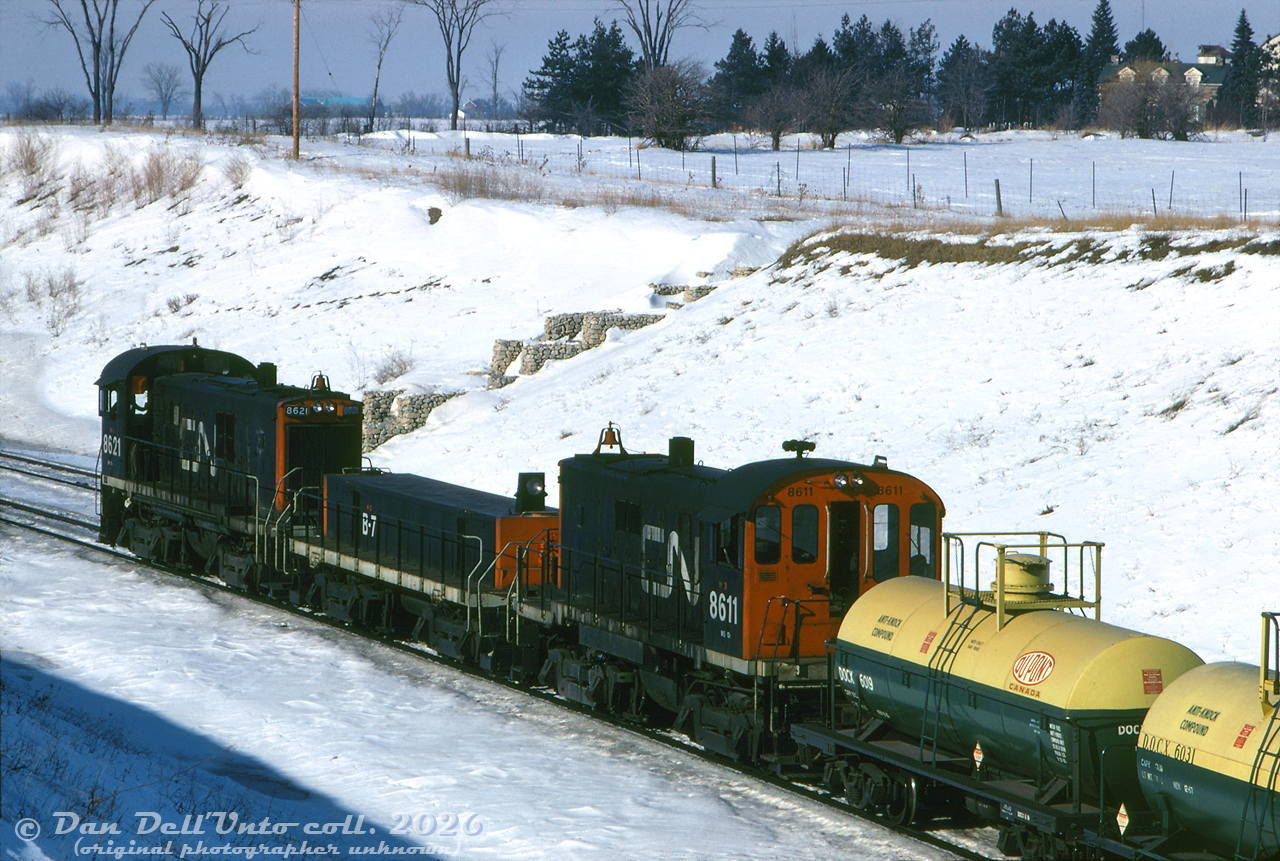
CN S13 units 8611 and 8621 bracket slug B7 on a hump set, working the Toronto Yard (later renamed MacMillan) hump on the pullback track north of Rutherford Road overpass. Two fresh-looking Dupont Canada anti-knock compound tank cars are coupled near the head end. When the yard opened, they used S13-slug-S13 sets designated in an H1-H2-H3 configuration, where H1 was the main unit outfitted with hump control, radio and signal equipment, H2 was the slug (converted from retired S3 units) and H3 was a trail-only unit with no special equipment aboard. The 8600's were a slightly heavier duty specified S13 than the 8500's, equipped with GE 752 traction motors, full automatic transition, MU, 26L brakes and extra weight.

This area of Vaughan (the old hamlet of Maple/Sherwood) was still very rural at the time, with no Canada's Wonderland or housing developments visible north of the yard. The farm and old stone farmhouse at the upper right was about where Seafield Road is today (suburban neighbourhood built in the 90's), and the farm and barns in the distance were way up at Major Mackenzie and Jane Street (southwest corner, where the Fortinos plaza is today).

Original photographer unknown (possibly Robbin Rekiel), Dan Dell'Unto collection slide.
Copyright Notice: This image ©Unknown, Dan Dell'Unto coll. all rights reserved.


Caption: CN S13 units 8611 and 8621 bracket slug B7 on a hump set, working the Toronto Yard (later renamed MacMillan) hump as they sit on the pullback track north of Rutherford Road overpass. Two fresh-looking Dupont Canada anti-knock compound tank cars are coupled near the head end.

When the yard opened in the mid-1960's, they used S13-slug-S13 sets designated in an H1-H2-H3 configuration (note red lettering above roadnumbers), where H1 was the main unit outfitted with hump control, radio and signal equipment, H2 was the slug (converted from retired S3 units) and H3 was a trail-only unit with no special equipment onboard. The 8600's were a slightly heavier duty specified MLW S13 than the 8500's, equipped with GE 752 traction motors, full automatic transition, MU, 26L brakes and extra weight. This power was later displaced by more powerful modified GP38-2 units and new GMD slugs in the late 70's.

This area of Vaughan (the old hamlet of Maple/Sherwood) was still very rural at the time, with no Canada's Wonderland or housing developments visible north of the yard. The farm and old stone farmhouse at the upper right was about where Seafield Road is today (suburban neighbourhood built in the 90's), and the farm and barns in the distance were way up at Major Mackenzie and Jane Street (southwest corner, where the Fortinos plaza is today).

Original photographer unknown (possibly Robbin Rekiel), Dan Dell'Unto collection slide.

Photographer:
Unknown, Dan Dell'Unto coll. [1217] (more) (contact)
Date: 01/21/1969 (search)
Railway: Canadian National (search)
Reporting Marks: CN 8611 B7 8621 (search)
Train Symbol: Not Provided
Subdivision/SNS: CN Toronto Yard (MacMillan Yard) (search)
City/Town: Vaughan (Maple) (search)
Province: Ontario (search)
Share Link: http://www.railpictures.ca/?attachment_id=59491
Click here to Log-in or Register and add your vote.

2 Favourites
Photographers like Gold.Log-in or Register to show appreciation
View count: 42 Views

Share this image on Facebook, Twitter or email using the icons below
Photo ID: 58156

Map courtesy of Open Street Map

Full size | Suncalc


All comments must be positive in nature and abide by site rules. Anything else may be removed without warning.

One Comment
  1. Cool, haven’t seen those tanks in a while. They are just like the Dupont (anti-knock/tetra-ethyl-lead) cars we unloaded at the IOL refinery in Edmonton. And of course, what went with the anti-knock compound, anti-knock engines. Fancy engines that were used at the refinery. By the way they pinged, this would tell you that the additives and blends were in the right ratios or not. :-)

Railpictures.ca © 2006-2026 all rights reserved. Photographs are copyright of the photographer and used with permission
Terms and conditions | About us