
Welcome Visitor. First time here? Like what you see? Bookmark us for when you are bored, and check out 'top shots' and 'fantastic (editors choice)' in the menu above, you won't be dissapointed. Join our community!
click here to sign up for an account today. Sick of this message? Get rid of it by
logging-in here.
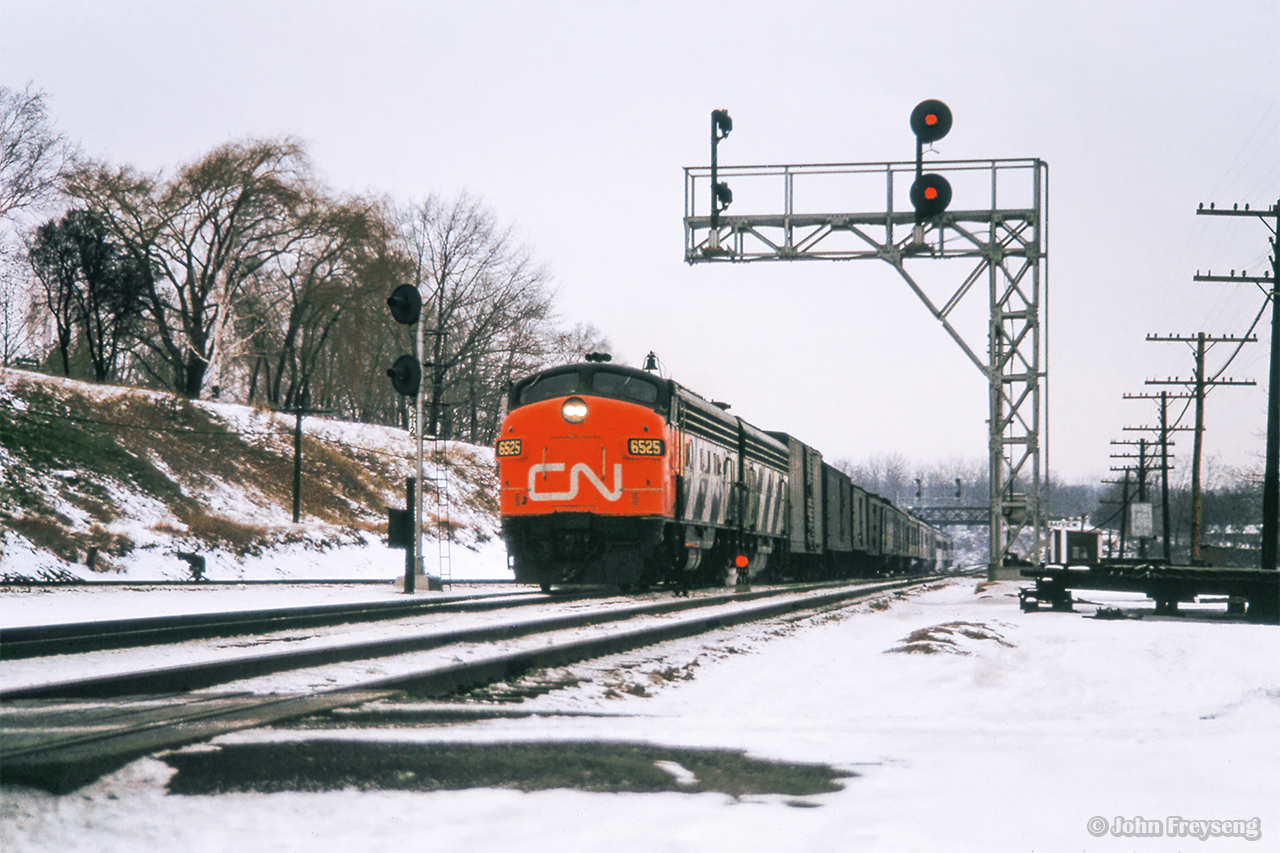

The signals are interesting in this photo. One set on the cantilever lack backboards. And there’s a dwarf signal under the cantilever which presumably governs the same track as the signal with backboards. Was this a transition period when the cantilever was first installed but not fully operational ?
On another note: running the train into Hamilton then backing out to proceed westerly was a bold move.
* meant to say the dwarf signal governed the same track as the signal “without” backboards.
Perhaps ABS directional running: north track westbound; south eastbound, prior to CTC.
My understanding is that most London / Windsor trains served Hamilton downtown – as such the departures would be reverse moves.
sdfourty
Correct.
Interlockings within ABS at CN were typically designed with a “High Signal” governing movements with the current of traffic (directional running) and a “Dwarf Signal” for movements running against the current of traffic. UCOR Rule 673 governed movements moving against the current of traffic approaching Interlocking Limits.
Bayview Interlocking is being upgraded as part of the CTC between Hamilton and Burlington and will be In Service in less than a year. The additional indications required for CTC necessitated the replacement of the Dwarf Signal with a two head high signal governing eastward movements. In the distance a similar signal configuration can be seen for westward movements.
Thanks for the explanation !