|
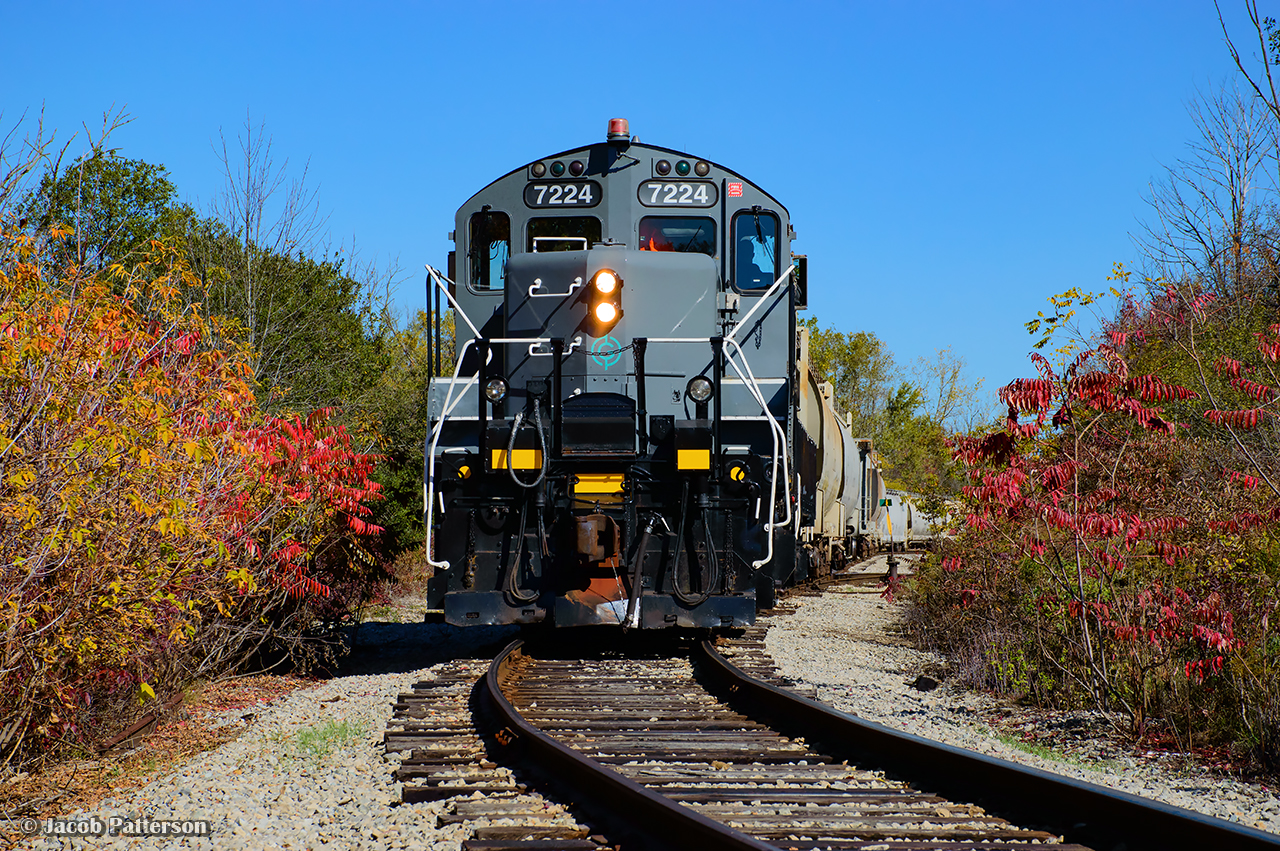
Caption: Where electrics once roamed. GIO's Welland job switches out cars for Ardent Milling, which will be transloaded on the westernmost track at the London Agricultural Commodities elevator (the former Robin Hood facility.)
Constructed in 1940, the Robin Hood Flour Mill received rail service from the Niagara, St. Catharines & Toronto Railway via a spur from their Welland Division mainline on Elm Street. An electric locomotive was based at the foot of Elm Street in Port Colborne as an outpost assignment, servicing this facility in what was then known as the community of Humberstone, amalgamating with Port Colborne in 1952. Electric service on the NS&T ceased in 1960, with CNR diesels taking over the assignment. The yard pictured contained only the main and east siding at the time, while over on Elm Street, a short stretch of the old NS&T main was kept south of Barrick Road for switching purposes. This arrangement remained until the connection at the north end of the elevator was constructed in 1983-1984 to the Canal Sub. Per Paul Duncan, this connection appears to have been the CN Casco Lead until being handed off to the Port Colborne Harbour Railway. The connection south to the former Dunnville Sub would be built in 1997 with startup of PCHR operations.
The Robin Hood Flour Mill would be closed in 2008 by Horizon Milling, and later sold to Ceres Global Ag in 2010 to be used primarily for grain storage and export. Space in the elevator would be leased to London Agricultural Commodities effective 2019, with LAC purchasing the facility in 2023. Shortly before the end of NS&T electric operations, this unit was built. Rolling out of GMDD London in 1955 as CNR 2013, this GP9 would be renumbered in 1956 to CN 4464. In 1986, it would be rebuilt as GP9RM 7224, and sold to Lambton Diesel Services in 2021.
Looking at 1930s aerial imagery, this site can be seen prior to the elevator's construction. Steve Host's recent research pointed out the abandoned right of way from the Welland Ship Canal Construction Railway. It would appear just north of the elevator location was a dump site for earth and other construction debris, and the construction "mainline" cut across the canal near this location. Comparing 1930s and 1940s imagery, one can see this track runs along the former construction railway right of way from the point where 7224 is seen above, right to the elevator silos.
|


Very nice.
Great shot and write up