Welcome Visitor. First time here? Like what you see? Bookmark us for when you are bored, and check out 'top shots' and 'fantastic (editors choice)' in the menu above, you won't be dissapointed. Join our community! click here to sign up for an account today. Sick of this message? Get rid of it by logging-in here.


Early on, when railways built their lines, sometimes they elected to build south of the namesake towns or cities, where costs for purchasing land were lower. The Grand Trunk was no exception, laying their double tracked mainline approx 1.7 km south from the town to where a small village was formed briefly known as 'Grafton Station'. 


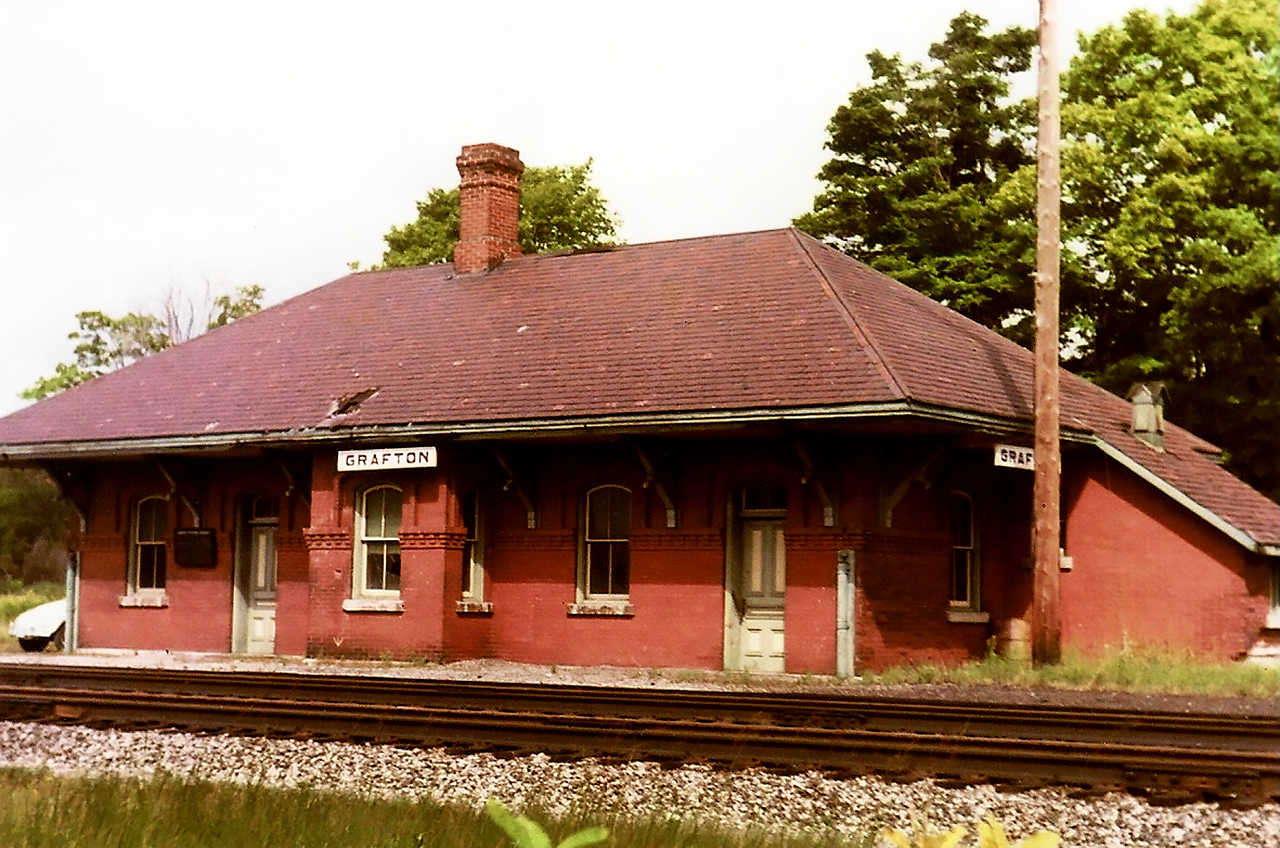
On a beautiful summer day, the red brick station sits quite picturesque, despite its days becoming numbered. Judging from the hole in the roof by the operators bay, the train order signal was removed and the station looks rather forlorn. However, this wasn't always the case. 


The main business, at least until ten years before (1950) was Canada Canning Co. In fact, some houses existed for those who worked there, along with homes for dome railway employees. Although most buildings were removed after the plants closure, not all was lost. Some of the remaining walls to the factory remained and have been repurposed into a vacation home for a Toronto couple. 


Although the small trackside village is no more, the main town exists in all its historical beauty. One can still go and railfan along the CN, or along the CP line that was built to compete for business. And, although the CN triple tracked the mainline, still to this day one can locate where Grafton had its small station, that stood through the glory days of steam and early days when diesel engines roamed the rails.
Copyright Notice: This image ©Todd Steinman all rights reserved.


Caption: Early on, when railways built their lines, sometimes they elected to build south of the namesake towns or cities, where costs for purchasing land were lower. The Grand Trunk was no exception, laying their double tracked mainline approx 1.7 km south from the town to where a small village was formed briefly known as 'Grafton Station'.
On a beautiful summer day, the red brick station sits quite picturesque, despite its days becoming numbered. Judging from the hole in the roof by the operators bay, the train order signal was removed and the station looks rather forlorn. However, this wasn't always the case.

The main business, at least until ten years before (1950) was Canada Canning Co. In fact, some houses existed for those who worked there, along with homes for dome railway employees. Although most buildings were removed after the plants closure, not all was lost. Some of the remaining walls to the factory remained and have been repurposed into a vacation home for a Toronto couple.

Although the small trackside village is no more, the main town exists in all its historical beauty. One can still go and railfan along the CN, or along the CP line that was built to compete for business. And, although the CN triple tracked the mainline, still to this day one can locate where Grafton had its small station, that stood through the glory days of steam and early days when diesel engines roamed the rails.

Photographer:
Todd Steinman [346] (more) (contact)
Date: Circa 1960 (search)
Railway: Canadian National (search)
Reporting Marks: Preservation (search)
Train Symbol: Preservation (search)
Subdivision/SNS: CN Kingston Subdivision (search)
City/Town: Grafton (search)
Province: Ontario (search)
Share Link: http://www.railpictures.ca/?attachment_id=60483
Click here to Log-in or Register and add your vote.

1 Favourites
Photographers like Gold.Log-in or Register to show appreciation
View count: 12 Views

Share this image on Facebook, Twitter or email using the icons below
Photo ID: 59143

Sorry, there is no map for this photo. Photographer did not add GPS co-ordinates. Please add next time or ask for a correction to this photo.


All comments must be positive in nature and abide by site rules. Anything else may be removed without warning.

One Comment
  1. I can imagine how solid this old structure was. They don’t build them like that any more.

Railpictures.ca © 2006-2026 all rights reserved. Photographs are copyright of the photographer and used with permission
Terms and conditions | About us